


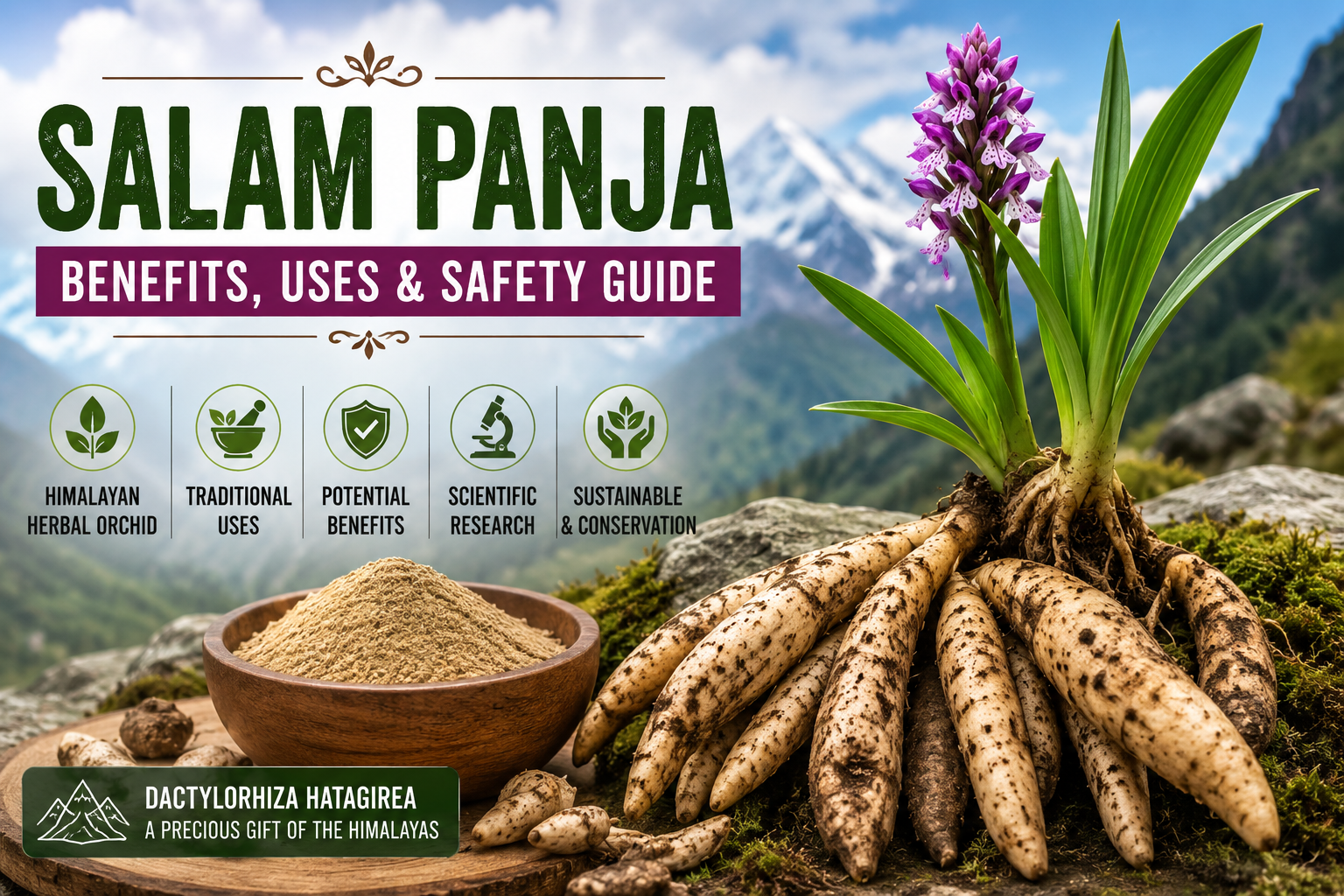
Salam Panja is a traditional Himalayan medicinal herb that has been used in various traditional healing practices for generations. It is commonly associated with Dactylorhiza hatagirea, a terrestrial orchid known for its distinctive finger-like underground tubers. In traditional herbal practices, Salam Panja is valued for its potential restorative, strengthening, and wellness-supporting properties.
Today, Salam Panja has become especially popular among people searching for natural ways to support physical strength, stamina, vitality, and men’s wellness. However, many claims made online are stronger than the available scientific evidence. While laboratory and traditional research has explored several potential properties of the plant, high-quality human clinical research is still limited.
This guide takes a balanced look at Salam Panja, covering its scientific identity, traditional uses, potential benefits, men’s health applications, safety, how it is used, and the importance of sustainable sourcing.
Important: Salam Panja is a common name that may refer to different plants in different regions. The material discussed in this article is primarily associated with Dactylorhiza hatagirea. Always check the scientific name and source before purchasing a herbal product.
What You’ll Learn
In this article, you will learn:
- What Salam Panja is
- Salam Panja’s scientific name
- Where the plant grows
- Traditional uses of Salam Panja
- Potential Salam Panja benefits
- Salam Panja benefits for men
- What scientific research says
- How Salam Panja powder is traditionally used
- Safety precautions and possible side effects
- How to identify a quality product
- Why conservation and sustainable sourcing matter
- Frequently asked questions about Salam Panja
What Is Salam Panja?
Salam Panja is a traditional name used for medicinal orchid tubers, most commonly associated with Dactylorhiza hatagirea in Himalayan herbal medicine. The plant belongs to the Orchidaceae family and grows naturally in high-altitude Himalayan environments.
The word “Panja” refers to the finger-like appearance of the plant’s underground tubers. These tubers are the part traditionally collected and used in various herbal preparations.
Unlike many common medicinal plants, Salam Panja is not simply a root. It is an underground tuber of a terrestrial orchid. This distinction is important because the botanical identity of a medicinal herb can influence its chemical composition, traditional uses, safety, and effectiveness.
Research on Dactylorhiza hatagirea has investigated its traditional uses, phytochemical compounds, pharmacological activities, and conservation challenges. Studies have reported interest in compounds such as dactylorhins and dactyloses, although more clinical research is needed to understand their effects in humans.
Quick Facts About Salam Panja
| Feature | Details |
|---|---|
| Common name | Salam Panja |
| Common botanical reference | Dactylorhiza hatagirea |
| Plant family | Orchidaceae |
| Plant type | Terrestrial orchid |
| Traditionally used part | Underground tuber |
| Natural habitat | Himalayan alpine and sub-alpine regions |
| Traditional applications | Restorative and wellness preparations |
| Research areas | Phytochemistry and pharmacology |
| Main concerns | Authenticity, overharvesting, and conservation |
One important point is that the name “Salam Panja” may not always refer to exactly the same botanical species. Therefore, consumers should look for the scientific name on product packaging whenever possible.
Salam Panja Scientific Name and Botanical Identity
The plant most commonly associated with Himalayan Salam Panja is Dactylorhiza hatagirea.
It belongs to the Orchidaceae family, which includes thousands of orchid species. Unlike decorative orchids, Dactylorhiza hatagirea is a terrestrial orchid that grows in soil and produces underground tubers.
The tubers are often described as palm- or finger-shaped, which explains the traditional name Salam Panja.
The plant’s botanical identity is important for several reasons.
Why correct identification matters
- Different plants can have similar local names.
- Herbal products can sometimes be adulterated.
- Different species may contain different chemical compounds.
- Scientific research usually applies to a specific botanical species.
- Safety information may not apply equally to unrelated plants.
If you are purchasing Salam Panja powder or dried material, choose products that clearly mention the scientific name, plant part, origin, and manufacturer.
Where Does Salam Panja Grow?
Dactylorhiza hatagirea is associated with the Himalayan mountain ecosystem and is found in high-altitude environments.
The plant has been reported from various Himalayan regions, including areas of India and neighboring Himalayan countries. It generally grows in alpine and sub-alpine habitats, where the climate is cold and the growing season is relatively short.
Typical environmental conditions include:
- High elevations
- Alpine meadows
- Moist mountain habitats
- Sub-alpine regions
- Cold climatic conditions
The plant’s natural habitat makes harvesting difficult. It also contributes to its commercial value and conservation challenges.
Because the underground tuber is the part traditionally collected, uncontrolled harvesting can negatively affect wild populations. This is one reason researchers have shown interest in cultivation and propagation techniques.
Traditional Uses of Salam Panja
Salam Panja has a long history of traditional use in Himalayan and South Asian herbal medicine.
Traditional practitioners have used preparations made from the tuber for various wellness purposes. These uses may differ between communities and traditional medicine systems.
Historically reported applications include support for:
- General weakness
- Physical vitality
- Restorative nutrition
- Digestive wellness
- Respiratory complaints
- Traditional reproductive health
- Wound-related preparations
- General convalescence
Some traditional preparations combine Salam Panja with milk, honey, ghee, or other herbs. However, the exact preparation method depends on the traditional system and the specific formulation.
It is important to understand that traditional use is not the same as modern clinical proof. Traditional knowledge can provide valuable clues for scientific research, but controlled human studies are necessary to confirm whether a particular health effect is effective and safe.
Salam Panja Benefits: What Are the Potential Benefits?
Salam Panja is often promoted as a strengthening and restorative herb. Scientific research has also investigated different biological properties of Dactylorhiza hatagirea.
However, the evidence is not equally strong for every claimed benefit.
The following sections distinguish between traditional use and modern scientific research.
1. May Support General Vitality
One of the most common traditional uses of Salam Panja is as a restorative herb.
It has traditionally been included in formulations intended to support people experiencing weakness or reduced vitality.
This reputation may explain why Salam Panja is often included in herbal wellness products marketed for strength and stamina.
However, there is limited clinical evidence to confirm that Salam Panja directly improves physical performance or energy levels in healthy adults.
Evidence level: Traditional use with limited clinical evidence.
2. Antioxidant Potential
Oxidative stress occurs when free radicals and the body’s antioxidant defenses become unbalanced.
Researchers have investigated various medicinal plants for antioxidant activity, including Dactylorhiza hatagirea.
Some laboratory research suggests that compounds found in the plant may demonstrate antioxidant activity.
However, an antioxidant effect observed in laboratory testing does not automatically mean that consuming the herb will prevent disease or produce a measurable health benefit in humans.
More research is needed to understand how these compounds behave in the human body.
Evidence level: Preliminary and mainly experimental.
3. Antimicrobial Potential
Another area of scientific interest is antimicrobial activity.
Some compounds derived from medicinal orchids have been investigated for their ability to affect microorganisms under laboratory conditions.
This research is valuable because medicinal plants can contain compounds that may eventually contribute to pharmaceutical research.
However, Salam Panja should not be considered a replacement for antibiotics or prescribed treatment for infections.
Evidence level: Preliminary laboratory research.
4. Anti-Inflammatory Potential
Inflammation plays a role in many health conditions.
Researchers have studied medicinal plants for compounds that may influence inflammatory pathways. Salam Panja has also attracted interest in this area.
The available evidence suggests potential biological activity, but there is currently not enough human clinical evidence to recommend Salam Panja as a treatment for inflammatory diseases.
Evidence level: Early-stage research.
5. Traditional Support During Weakness
In traditional medicine, Salam Panja has been valued as a restorative ingredient.
It may be included in formulations designed to provide nourishment and support recovery after periods of weakness.
This traditional use is one reason it is sometimes classified as a tonic or strengthening herb in herbal marketing.
However, unexplained weakness can be caused by medical conditions such as anemia, nutritional deficiencies, thyroid disorders, diabetes, infections, or other health problems. Persistent fatigue should therefore be evaluated by a healthcare professional.
6. Traditional Reproductive Wellness
Salam Panja is sometimes associated with reproductive health in traditional medicine.
It is commonly marketed today for male vitality and sexual wellness. However, online claims often go far beyond the available evidence.
There is currently insufficient high-quality human research to conclude that Salam Panja can reliably:
- Increase testosterone
- Cure erectile dysfunction
- Treat infertility
- Increase sperm count
- Improve fertility
- Produce dramatic improvements in sexual performance
These claims should therefore be approached with caution.
Evidence level: Traditional use and preliminary research; insufficient clinical evidence for strong medical claims.
Salam Panja Benefits for Men
One of the most popular search queries related to this herb is “Salam Panja benefits for men.”
The interest comes from its traditional reputation as a strengthening and restorative herb.
Some herbal products market Salam Panja for:
- Male vitality
- Physical strength
- Stamina
- Sexual wellness
- Reproductive health
- General energy
However, the scientific evidence does not currently support making strong promises about these effects.
For example, if someone experiences low libido or erectile difficulties, the underlying cause may involve stress, medication, diabetes, cardiovascular health, hormonal changes, or other medical factors.
Therefore, Salam Panja should not be viewed as a guaranteed solution.
A sensible approach
If you are considering Salam Panja for men’s wellness:
- Check the botanical identity.
- Choose a reputable product.
- Avoid products making miracle claims.
- Follow the recommended serving instructions.
- Consult a healthcare professional if symptoms persist.
- Do not stop prescribed treatment without medical advice.
This approach is safer and more evidence-based than relying on exaggerated marketing claims.
How to Use Salam Panja Powder
Salam Panja may be available as a dried tuber or powdered herbal ingredient.
Traditional preparations may mix the powder with ingredients such as milk or honey. However, there is no universally established clinical dosage that can be recommended for everyone based on current human research.
If you purchase a commercial product, follow the manufacturer’s instructions.
Steps for responsible use
- Confirm the plant identity
Check whether the product identifies Dactylorhiza hatagirea or another species. - Check the label
Look for the plant part, ingredients, manufacturer, batch number, and expiry date. - Start with the recommended serving
Never assume that a larger quantity will produce better results. - Avoid unnecessary combinations
Combining several concentrated herbal supplements may increase the risk of unwanted effects or interactions. - Monitor your response
Stop using the product and seek professional advice if you experience unusual symptoms.
Important Note
Natural products are not automatically risk-free. Herbal supplements can vary in purity, concentration, and quality.
Salam Panja Side Effects and Safety
Compared with well-studied medicinal herbs, the safety profile of Salam Panja has not been investigated as extensively.
Potential concerns may include:
- Allergic reactions
- Digestive discomfort
- Contamination
- Adulteration
- Incorrect botanical identification
- Drug interactions
- Unknown effects from long-term use
Because safety research is limited, caution is especially important.
Who should consult a healthcare professional?
Talk to a qualified healthcare provider before using Salam Panja if you:
- Are pregnant
- Are breastfeeding
- Take prescription medicines
- Have a chronic disease
- Have allergies
- Are preparing for surgery
- Are considering giving it to a child
People with medical conditions should not use Salam Panja as a replacement for prescribed treatment.
How to Choose Genuine Salam Panja
Authenticity is a major issue when purchasing traditional herbal products.
The name “Salam Panja” can vary between regions, and herbal products may sometimes be sold without clear botanical identification.
Look for these details:
- Scientific name
- Plant part used
- Country or region of origin
- Manufacturer details
- Batch number
- Manufacturing date
- Expiry date
- Quality testing information
Avoid products that:
- Promise instant results
- Guarantee increased testosterone
- Claim to permanently cure erectile dysfunction
- Promise infertility cures
- Make unrealistic sexual performance claims
- Hide the botanical identity
- Have no manufacturer information
A trustworthy herbal seller should be transparent about the product’s ingredients and source.
Salam Panja and Conservation: Why Sustainable Sourcing Matters
The conservation story of Salam Panja is an important topic that many commercial articles overlook.
Wild populations of Dactylorhiza hatagirea have faced pressure from collection and habitat changes. Because the underground tuber is traditionally harvested, removing the plant from the wild can affect natural regeneration.
This creates a challenge:
High consumer demand + wild harvesting + slow natural regeneration = conservation pressure.
Responsible sourcing can help by:
- Supporting cultivated material
- Choosing traceable suppliers
- Avoiding illegally harvested products
- Supporting conservation programs
- Encouraging sustainable cultivation
- Raising awareness about threatened medicinal plants
Researchers have investigated propagation and cultivation techniques as possible approaches to reduce pressure on wild populations.
Consumers can play a role by making informed purchasing decisions.
Salam Panja vs. Other Herbal Strength Herbs
| Feature | Salam Panja | Ashwagandha | Shilajit | Kaunch Beej |
| Botanical source | Medicinal orchid tuber | Root | Mineral-rich resinous substance | Seed |
| Traditional use | Restorative and strengthening | Stress and vitality | Traditional vitality support | Traditional reproductive wellness |
| Scientific research | Developing | Extensive compared with Salam Panja | Growing | Developing |
| Human evidence | Limited | Moderate but indication-specific | Limited to moderate depending on claim | Limited |
| Major concern | Conservation and authenticity | Product quality and interactions | Purity and contamination | Correct preparation and dosage |
The important lesson is that herbal products should not be treated as interchangeable.
Every plant has its own:
- Chemistry
- Evidence base
- Safety profile
- Traditional history
- Quality concerns
- Sustainability issues
What Does Scientific Research Say About Salam Panja?
Scientific research on Dactylorhiza hatagirea has explored its botanical characteristics, traditional applications, phytochemical composition, pharmacological activities, and conservation.
Researchers have identified various chemical constituents and investigated potential biological activities.
However, the overall evidence should be interpreted carefully.
Current evidence can be summarized as follows:
| Potential claim | Current evidence |
| Traditional strengthening use | Well documented traditionally |
| Antioxidant activity | Preliminary research |
| Antimicrobial activity | Mainly laboratory evidence |
| Anti-inflammatory potential | Preliminary |
| General vitality | Traditional use |
| Male sexual wellness | Limited clinical evidence |
| Testosterone enhancement | Not sufficiently established |
| Infertility treatment | Not clinically established |
| Erectile dysfunction treatment | Not clinically established |
| Long-term safety | More research needed |
This distinction between traditional knowledge and clinical evidence is essential.
A plant can have an interesting chemical profile without being a proven treatment for a specific medical condition.
Common Mistakes People Make When Buying Salam Panja
Mistake 1: Buying only by the common name
Common names can be confusing.
Better approach: Check the scientific name.
Mistake 2: Believing every online claim
Some websites promise dramatic results.
Better approach: Look for scientific sources and realistic claims.
Mistake 3: Assuming natural means safe
Natural products can still cause adverse reactions or interact with medicines.
Better approach: Consider your health status and medications.
Mistake 4: Ignoring sustainability
Wild harvesting can put pressure on medicinal plants.
Better approach: Prefer traceable and responsibly sourced products.
Mistake 5: Taking more for faster results
Higher amounts are not necessarily better.
Better approach: Follow product instructions and professional advice.
Frequently Asked Questions About Salam Panja
Is Salam Panja the same as Dactylorhiza hatagirea?
Salam Panja is commonly associated with Dactylorhiza hatagirea in Himalayan herbal medicine. However, common names can vary between regions, so botanical identification is important.
What are the main Salam Panja benefits?
Traditional uses focus on restorative health, strength, vitality, and wellness. Scientific research has explored antioxidant, antimicrobial, and other potential biological activities, but strong human clinical evidence remains limited.
Is Salam Panja good for men’s health?
Salam Panja is traditionally associated with male vitality and reproductive wellness. However, there is insufficient clinical evidence to confirm that it reliably increases testosterone or treats erectile dysfunction or infertility.
Does Salam Panja increase testosterone?
There is currently insufficient high-quality human evidence to confirm that Salam Panja consistently increases testosterone levels.
How do you take Salam Panja powder?
Salam Panja powder is traditionally used in different preparations. Because standardized clinical dosing is not well established, follow the manufacturer’s directions or consult a qualified healthcare professional.
Is Salam Panja safe?
The available safety research is limited. Product quality, correct identification, dosage, possible interactions, and individual health conditions should all be considered.
Can Salam Panja cure erectile dysfunction?
There is insufficient clinical evidence to recommend Salam Panja as a treatment for erectile dysfunction. Persistent symptoms should be discussed with a healthcare professional.
Why is Salam Panja expensive?
Its high-altitude habitat, collection challenges, demand, limited availability, and conservation concerns may contribute to its value.
Where does Salam Panja grow?
The plant associated with Salam Panja, Dactylorhiza hatagirea, is found in Himalayan alpine and sub-alpine environments.
Is Salam Panja endangered?
The conservation status should be checked for the exact botanical species and current assessment. Research has highlighted concerns about overharvesting and habitat pressure affecting Dactylorhiza hatagirea.
Can women use Salam Panja?
Traditional uses vary, but there is insufficient clinical evidence to make broad recommendations. Women who are pregnant, breastfeeding, or taking medication should seek professional advice before use.
Can Salam Panja replace medicine?
No. Salam Panja should not replace prescribed medicines or professional medical care.
How can I identify genuine Salam Panja?
Look for the scientific name, reputable manufacturer, clear ingredient information, batch details, and quality-testing information. Avoid products with exaggerated claims.
Final Thoughts on Salam Panja
Salam Panja is a fascinating traditional Himalayan medicinal herb with a long history of use and growing scientific interest. The plant most commonly associated with the name, Dactylorhiza hatagirea, is a distinctive terrestrial orchid valued for its underground tubers.
Traditional practices have associated Salam Panja with strength, vitality, restorative wellness, and reproductive health. Modern research has explored its phytochemical composition and potential antioxidant, antimicrobial, anti-inflammatory, and other biological properties.
However, it is important to separate traditional use from proven medical benefits. At present, there is not enough high-quality human evidence to support strong claims that Salam Panja can increase testosterone, cure infertility, or treat erectile dysfunction.
The most responsible way to approach Salam Panja is to focus on correct botanical identification, quality, safety, realistic expectations, and sustainable sourcing.
For consumers, the best product is not necessarily the one making the biggest promises. It is the one that provides the clearest information about what is inside the product, where it came from, and how it was produced.
As interest in Himalayan medicinal plants continues to grow, responsible research and conservation will be just as important as traditional knowledge in determining the future of Salam Panja.


