


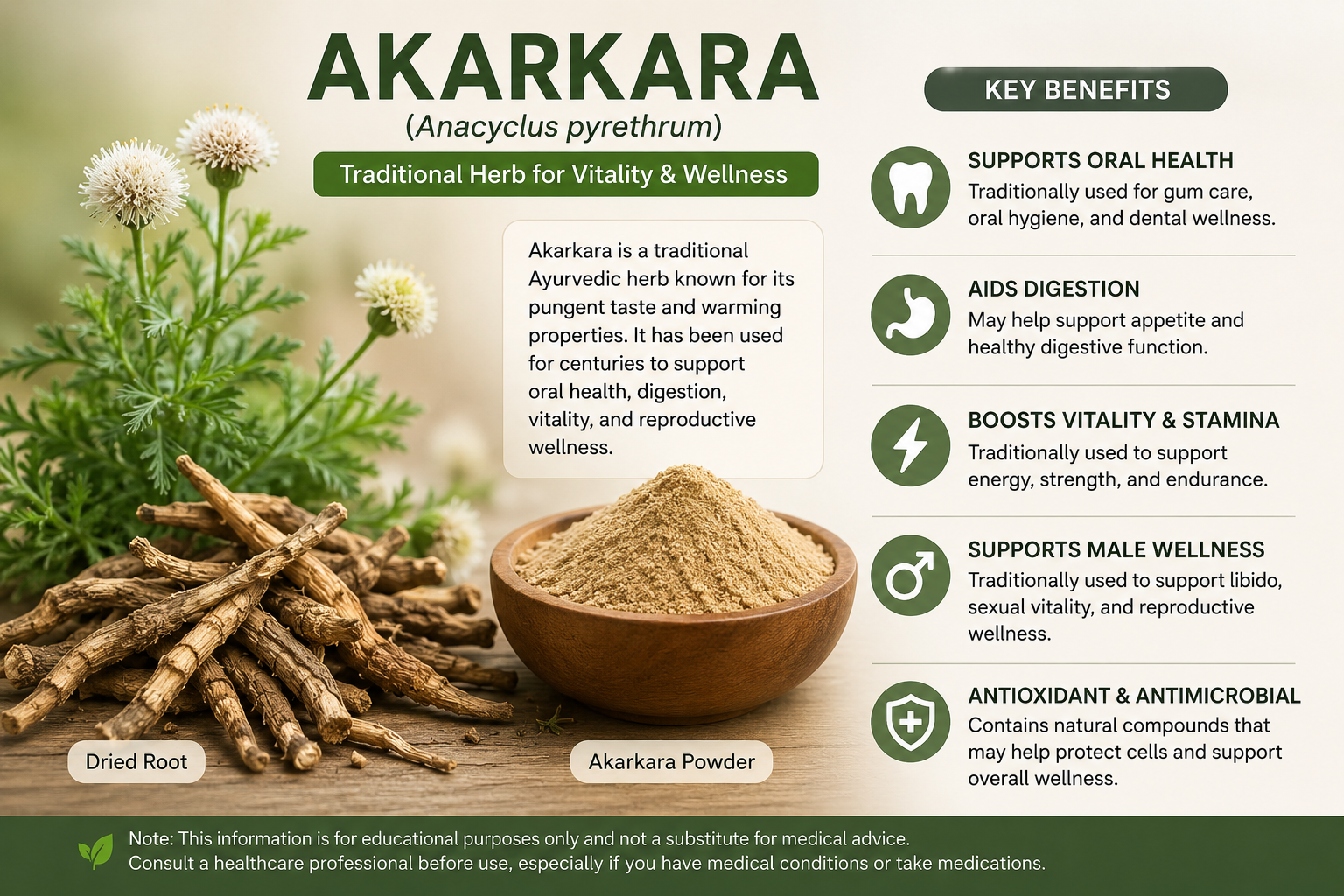
Akarkara is a traditional medicinal herb that has been used for centuries in Ayurveda and other traditional systems of medicine. Known for its strong, pungent taste and warming properties, Akarkara is commonly associated with oral health, digestion, vitality, and reproductive wellness.
The herb is particularly popular among people searching for natural ways to support energy, stamina, libido, and overall well-being. At the same time, many health claims made online about Akarkara are stronger than the available scientific evidence.
So, what is Akarkara really used for? Does it increase testosterone? How should Akarkara powder be used? Are there any side effects?
This complete guide explains the traditional uses, potential benefits, scientific research, dosage considerations, safety precautions, and common questions about Akarkara.
Important: Akarkara should not be considered a replacement for professional medical care. Many traditional uses have limited clinical evidence, and anyone with a medical condition or taking medication should consult a qualified healthcare professional before using it.
What You’ll Learn
In this guide, you will learn:
- What Akarkara is
- The scientific name of Akarkara
- Traditional Ayurvedic uses
- Potential Akarkara benefits
- Akarkara benefits for men
- Its possible role in sexual wellness
- How Akarkara powder is used
- Dosage considerations
- Side effects and safety precautions
- How to choose good-quality Akarkara
- What modern research says
- Frequently asked questions
What Is Akarkara?
Akarkara is a traditional medicinal herb commonly identified with the root of Anacyclus pyrethrum, a flowering plant belonging to the Asteraceae family. The herb is also known by names such as Pellitory, Pellitory root, Aqarqarha, and Akarakarabha.
The root is the most commonly used part of the plant. It has a distinctive pungent taste and produces a warming, tingling sensation when chewed or used in traditional preparations.
The botanical name generally associated with Akarkara is:
Scientific name: Anacyclus pyrethrum (L.) Lag.
Family: Asteraceae
Common English name: Pellitory
Main part used: Root
Akarkara has a long history in traditional medicine, where it has been included in preparations for oral care, digestion, vitality, and reproductive health.
However, traditional use and modern clinical evidence are not the same. While laboratory and animal research has investigated several properties of the plant, more high-quality human studies are needed to confirm many of its popular health claims.
Akarkara in Ayurveda
In Ayurveda, Akarkara is traditionally valued for its pungent and stimulating nature. It has been used in different herbal formulations for purposes related to digestion, oral health, vitality, and reproductive wellness.
Traditional herbal practitioners have used Akarkara in preparations associated with:
- Supporting digestion
- Encouraging appetite
- Traditional oral care
- Supporting general vitality
- Promoting physical strength
- Supporting reproductive wellness
- Traditional aphrodisiac preparations
The herb’s strong taste and warming sensation are among the reasons it has traditionally been considered stimulating.
However, Ayurvedic use is based on a traditional system of medicine and should not automatically be interpreted as proof of effectiveness according to modern clinical standards.
A responsible approach is to understand both sides:
Traditional evidence: Akarkara has a long history of use.
Modern scientific evidence: Research is still developing, and clinical evidence for many specific health claims remains limited.
Akarkara Benefits: Potential Health Benefits and Uses
Akarkara is widely discussed for its potential health benefits. Some benefits are based on traditional use, while others are being investigated through laboratory and preclinical research.
Let’s look at the most commonly discussed uses.
1. May Support Traditional Oral Health
One of the traditional uses of Akarkara is oral and dental care.
The root’s pungent compounds can create a warming and tingling sensation in the mouth. This property has contributed to its use in traditional oral preparations.
Traditionally, Akarkara has been associated with:
- Gum care
- Oral hygiene
- Tooth-related discomfort
- Salivation
- Traditional dental formulations
However, Akarkara should not replace professional dental care.
If you have severe tooth pain, bleeding gums, swelling, a dental abscess, or a persistent oral infection, consult a dentist. Herbal preparations may provide temporary sensations or traditional support but cannot replace treatment for underlying dental disease.
Practical Tip
If you are interested in using Akarkara for oral care, choose a properly formulated product rather than applying concentrated raw powder directly to sensitive gums or damaged tissue.
2. May Support Digestion
Akarkara has traditionally been used in herbal preparations intended to support digestive function.
Its pungent nature is traditionally associated with stimulating digestive activity and appetite.
People may use traditional Akarkara preparations for:
- Supporting appetite
- Digestive sluggishness
- General digestive comfort
- Supporting the body’s traditional digestive processes
However, modern clinical evidence is not strong enough to say that Akarkara can treat digestive disorders.
If you have ongoing abdominal pain, severe acidity, unexplained weight loss, persistent diarrhea, constipation, or blood in your stool, seek medical attention instead of relying solely on herbal remedies.
3. May Support Energy and Vitality
Akarkara is often included in traditional formulations designed to support general vitality.
It is commonly promoted for:
- Energy
- Physical vitality
- Stamina
- General strength
- Recovery and wellness
These traditional uses have contributed to the herb’s popularity among people looking for natural wellness supplements.
However, there is not enough high-quality human evidence to confirm that Akarkara directly improves athletic performance or provides a significant increase in physical strength.
A healthy diet, regular exercise, adequate sleep, and treatment of underlying health conditions remain the foundation of long-term energy and stamina.
4. Traditional Use for Sexual Wellness
Akarkara is one of the herbs frequently discussed in connection with male sexual health.
Traditional herbal formulations may use Akarkara to support:
- Libido
- Sexual vitality
- Stamina
- Reproductive wellness
- General male vitality
This is one of the main reasons people search for “Akarkara benefits for men.”
However, it is important to distinguish traditional use from established medical evidence.
There is currently insufficient high-quality human evidence to conclude that Akarkara can reliably:
- Increase testosterone
- Cure erectile dysfunction
- Treat infertility
- Increase sperm count
- Correct hormonal disorders
Some preliminary research has created interest in the plant’s possible reproductive and aphrodisiac properties, but stronger human studies are needed.
Expert Recommendation
If you have persistent low libido or erectile difficulties, consider speaking with a healthcare professional. Sexual health problems can sometimes be related to diabetes, cardiovascular disease, hormonal imbalances, stress, medication side effects, or other underlying conditions.
5. May Have Antioxidant Properties
Plants contain naturally occurring compounds that may have antioxidant activity.
Research into Anacyclus pyrethrum has examined several phytochemicals and their potential biological effects.
Antioxidant research is interesting because oxidative stress is involved in many biological processes.
However, laboratory antioxidant activity does not automatically mean that consuming Akarkara will produce a clinically meaningful antioxidant effect in humans.
More human research is needed to understand the real-world health implications.
6. May Have Antimicrobial Potential
Some laboratory research has investigated the antimicrobial properties of compounds found in medicinal plants, including Anacyclus pyrethrum.
This has created interest in potential applications involving:
- Oral microorganisms
- Bacterial activity
- Traditional dental care
- Herbal formulations
However, laboratory findings should not be confused with clinical treatment.
Akarkara should not be used as a substitute for antibiotics or medical treatment for a confirmed infection.
7. May Support Traditional Nervous System Wellness
Akarkara has also attracted scientific interest because of its traditional use in formulations related to nervous system health.
Researchers have investigated the plant’s phytochemicals and possible pharmacological activities.
However, most of the evidence remains preliminary.
There is currently insufficient clinical evidence to recommend Akarkara as a treatment for neurological disorders or mental health conditions.
Akarkara and Its Important Compounds
The biological properties of Akarkara are believed to be related to several naturally occurring phytochemicals.
Research has identified or investigated compounds such as:
- Alkylamides
- Pellitorin
- Anacyclin
- Phenylethylamine
- Inulin
- Polyacetylenes
- Sterols
- Fatty acids
- Flavonoids
- Tannins
- Coumarins
Among these, alkylamides have received particular scientific attention.
These compounds are associated with the characteristic pungent and tingling sensation produced by the root.
The chemical composition of Akarkara can vary depending on factors such as:
- Plant origin
- Soil conditions
- Harvesting methods
- Storage
- Processing
- Extraction techniques
This is one reason why different Akarkara products may not have identical effects.
Akarkara Benefits for Men
Akarkara is particularly popular in men’s wellness products.
It is traditionally associated with:
- Libido support
- Sexual vitality
- Physical stamina
- Reproductive wellness
- General energy
But many online claims about Akarkara are exaggerated.
Does Akarkara Increase Testosterone?
There is not enough high-quality human evidence to confirm that Akarkara reliably increases testosterone levels.
Some preliminary research has generated interest in the herb’s possible reproductive effects, but that is not the same as proving a testosterone-boosting effect in humans.
If you suspect low testosterone, the best approach is to speak with a healthcare professional and get appropriate testing.
Low testosterone may be associated with:
- Age
- Obesity
- Poor sleep
- Stress
- Certain medications
- Hormonal disorders
- Chronic illness
Treating the underlying cause is more important than relying on a single herbal ingredient.
Akarkara for Sexual Health
Akarkara has traditionally been included in some Ayurvedic and herbal formulations for sexual wellness.
Potential traditional applications include:
- Supporting libido
- Promoting sexual vitality
- Supporting stamina
- Supporting reproductive health
However, there is not enough clinical evidence to describe Akarkara as a proven treatment for sexual dysfunction or infertility.
Anyone experiencing persistent sexual problems should consider a medical evaluation.
For example, erectile dysfunction may sometimes be an early sign of cardiovascular or metabolic problems.
Akarkara for Women
Information about Akarkara for women is less extensive than information about its traditional use in male vitality formulations.
There is insufficient clinical evidence to recommend Akarkara for specific women’s health conditions.
Women should be particularly cautious if they are:
- Pregnant
- Breastfeeding
- Trying to conceive
- Undergoing fertility treatment
- Taking hormonal medication
- Managing a chronic condition
Consult a qualified healthcare professional before using Akarkara in these situations.
How to Use Akarkara Powder
Akarkara is available in several forms, including:
- Root powder
- Dried root
- Capsules
- Extracts
- Herbal formulations
The method of use depends on the product.
General Steps
- Check the product label.
- Confirm that the botanical name is Anacyclus pyrethrum.
- Check whether it is a powder or concentrated extract.
- Follow the manufacturer’s recommended serving instructions.
- Avoid combining multiple supplements containing the same herb.
- Stop using the product if you experience significant adverse effects.
Can Akarkara Powder Be Taken Every Day?
There is no universally established daily dose that is appropriate for every person.
The appropriate amount may depend on:
- Product concentration
- Root powder versus extract
- Individual health
- Other medications
- The purpose of use
- Traditional formulation
Because concentrated extracts can differ greatly from raw powder, a fixed dose should not be assumed to work for everyone.
For regular use, professional guidance is recommended.
Akarkara Dosage
One of the most common questions is: How much Akarkara should I take?
The answer is not as simple as a single number.
Different products have different concentrations and formulations. A raw root powder is not equivalent to a standardized extract.
Before using Akarkara, consider:
- The form of the product
- The concentration
- The manufacturer’s instructions
- Your health status
- Your medications
- The reason you want to use it
Avoid taking larger amounts simply because you believe a higher dose will provide faster results.
With herbal supplements, more is not always better.
Akarkara Side Effects
Akarkara is a biologically active herb and may cause unwanted effects in some people.
Potential side effects may include:
- Mouth irritation
- Burning sensation
- Tingling
- Increased salivation
- Stomach discomfort
- Heartburn
- Nausea
- Allergic reactions
Some people may be more sensitive than others.
If you experience severe irritation, swelling, difficulty breathing, or other serious symptoms, stop using the product and seek medical attention.
Who Should Avoid or Use Caution With Akarkara?
Speak with a healthcare professional before using Akarkara if you:
- Are pregnant
- Are breastfeeding
- Have a chronic medical condition
- Take prescription medication
- Have known allergies to herbs
- Have a planned surgery
- Use multiple herbal supplements
People with allergies to members of the Asteraceae family may also want to exercise caution.
Because research on herb-drug interactions is incomplete, it is wise to tell your doctor about all supplements you use.
How to Choose Good-Quality Akarkara
The quality of herbal supplements can vary significantly.
Before buying Akarkara, look for:
1. Correct Botanical Name
Check whether the label clearly identifies Anacyclus pyrethrum.
2. Clear Ingredients
The product should clearly state whether it contains root powder or extract.
3. Manufacturer Details
Choose products from established manufacturers that provide transparent information.
4. Batch Information
Look for batch numbers, manufacturing information, and expiry dates.
5. Quality Testing
If available, choose products that provide credible testing information.
Avoid Products That:
- Promise instant testosterone increases
- Claim to cure infertility
- Guarantee permanent sexual performance
- Claim to cure serious diseases
- Hide the ingredient list
- Make unrealistic “100% safe” claims
A trustworthy herbal product should provide clear information without making impossible promises.
Akarkara vs Ashwagandha vs Shilajit
| Feature | Akarkara | Ashwagandha | Shilajit |
|---|---|---|---|
| Traditional focus | Pungent stimulant and vitality | Stress, strength and general wellness | Energy and vitality |
| Common form | Root powder | Root powder/extract | Resin/extract |
| Traditional association | Oral care and vitality | Adaptogenic wellness | Physical vitality |
| Flavor | Strong and pungent | Earthy and bitter | Resinous |
| Research | Developing | More extensively researched | Developing |
| Main consideration | Irritation and tolerance | Potential interactions | Product purity and contamination |
These herbs are not interchangeable. Each has a different traditional history and research profile.
What Does Modern Research Say About Akarkara?
Modern research on Anacyclus pyrethrum has examined several areas, including:
- Phytochemistry
- Alkylamides
- Pellitorin
- Antioxidant activity
- Antimicrobial activity
- Reproductive effects
- Nervous system activity
- Traditional medicinal applications
- Toxicology
A systematic review of Anacyclus pyrethrum discussed its traditional uses, phytochemical constituents, pharmacological activities, and toxicological considerations.
The research is promising in some areas, but many studies are laboratory-based or preclinical.
This means there is still a gap between:
Traditional use → Laboratory research → Animal research → Human clinical evidence
A health claim becomes much stronger when it is supported by well-designed human clinical trials.
For Akarkara, more high-quality human research is needed.
Akarkara: Traditional Claims vs Scientific Evidence
| Potential Use | Traditional Support | Research Interest | Human Evidence |
| Oral health | High | Yes | Limited |
| Digestion | High | Some | Limited |
| General vitality | High | Some | Limited |
| Libido | High | Yes | Insufficient |
| Testosterone | Popular claim | Preliminary interest | Insufficient |
| Antioxidant activity | — | Yes | Limited |
| Antimicrobial activity | — | Yes | Mostly laboratory |
| Reproductive wellness | Traditional | Yes | Limited |
This table highlights an important point: not every popular health claim has the same level of evidence.
Common Mistakes People Make When Using Akarkara
Mistake 1: Assuming Natural Means Safe
Natural products can still cause side effects or interact with medications.
Mistake 2: Taking Too Much
Higher doses do not necessarily mean better results.
Mistake 3: Believing Every Online Claim
Claims about instant testosterone increases or guaranteed sexual benefits should be viewed critically.
Mistake 4: Ignoring the Botanical Name
Common names can vary. Checking the scientific name helps reduce confusion.
Mistake 5: Using It Instead of Medical Treatment
Herbal supplements should not replace appropriate treatment for serious health conditions.
Mistake 6: Buying Poor-Quality Products
Choose products with transparent labels and reliable manufacturing information.
Frequently Asked Questions About Akarkara
What is Akarkara?
Akarkara is a traditional medicinal herb commonly associated with the root of Anacyclus pyrethrum. It is also known as Pellitory or Pellitory root and has been used traditionally for oral care, digestion, vitality, and reproductive wellness.
What are the main benefits of Akarkara?
Traditional uses of Akarkara include supporting oral health, digestion, vitality, and sexual wellness. Modern research is investigating its phytochemicals and possible biological effects, but evidence varies by use.
Does Akarkara increase testosterone?
There is insufficient high-quality human evidence to confirm that Akarkara reliably increases testosterone.
Is Akarkara good for men?
Akarkara has traditionally been used in some formulations for male vitality and sexual wellness. However, it is not a proven treatment for low testosterone, infertility, or erectile dysfunction.
Can women use Akarkara?
Women should use Akarkara cautiously, especially during pregnancy, breastfeeding, or fertility treatment. Professional advice is recommended.
What are Akarkara side effects?
Possible side effects include mouth irritation, burning or tingling, increased salivation, stomach discomfort, heartburn, nausea, and allergic reactions.
Can Akarkara be taken daily?
There is no universally established daily dose for everyone. Daily use should depend on the product, preparation, individual health, and professional guidance.
How do you use Akarkara powder?
Akarkara powder should be used according to the product label or advice from a qualified healthcare professional. The appropriate amount depends on whether the product is raw root powder or a concentrated extract.
What is the scientific name of Akarkara?
The scientific name commonly associated with Akarkara is Anacyclus pyrethrum (L.) Lag.
Is Akarkara the same as Pellitory?
Akarkara is commonly associated with Pellitory or Pellitory root, referring to Anacyclus pyrethrum. Because common names can vary, checking the botanical name is recommended.
Can Akarkara cure erectile dysfunction?
There is insufficient clinical evidence to say that Akarkara can cure erectile dysfunction. Persistent erectile problems should be evaluated by a healthcare professional.
Is Akarkara scientifically proven?
Research has identified several interesting phytochemicals and biological activities, but many popular health claims require more high-quality human clinical research.
Can Akarkara treat toothache?
Akarkara has traditional oral-care uses, but it should not replace dental treatment. Persistent tooth pain may indicate an infection, cavity, or another condition requiring professional care.
How should Akarkara powder be stored?
Store it in a tightly closed container away from moisture, excessive heat, and direct sunlight. Follow the storage instructions provided by the manufacturer.
What should I check before buying Akarkara?
Check the botanical name, ingredient list, manufacturer details, batch information, expiry date, and quality-testing information. Avoid products that make exaggerated medical claims.
Conclusion
Akarkara is a traditional medicinal root with a long history of use in Ayurveda and herbal medicine. It is commonly associated with oral care, digestion, vitality, and reproductive wellness.
Modern research has increased interest in the plant because of compounds such as alkylamides and pellitorin. Researchers are exploring its potential antioxidant, antimicrobial, reproductive, and other biological activities.
However, it is important to maintain realistic expectations. Akarkara should not be considered a guaranteed testosterone booster, sexual-performance enhancer, or cure for infertility or disease. Many of these claims require stronger human clinical evidence.
If you are considering Akarkara, choose a reputable product, follow appropriate usage instructions, avoid excessive amounts, and consult a qualified healthcare professional if you have a medical condition or take medication.
The best way to approach Akarkara is to respect its traditional history while also understanding the limits of modern scientific evidence. This balanced approach can help you make a more informed decision about whether this traditional herb is appropriate for your wellness goals.


