


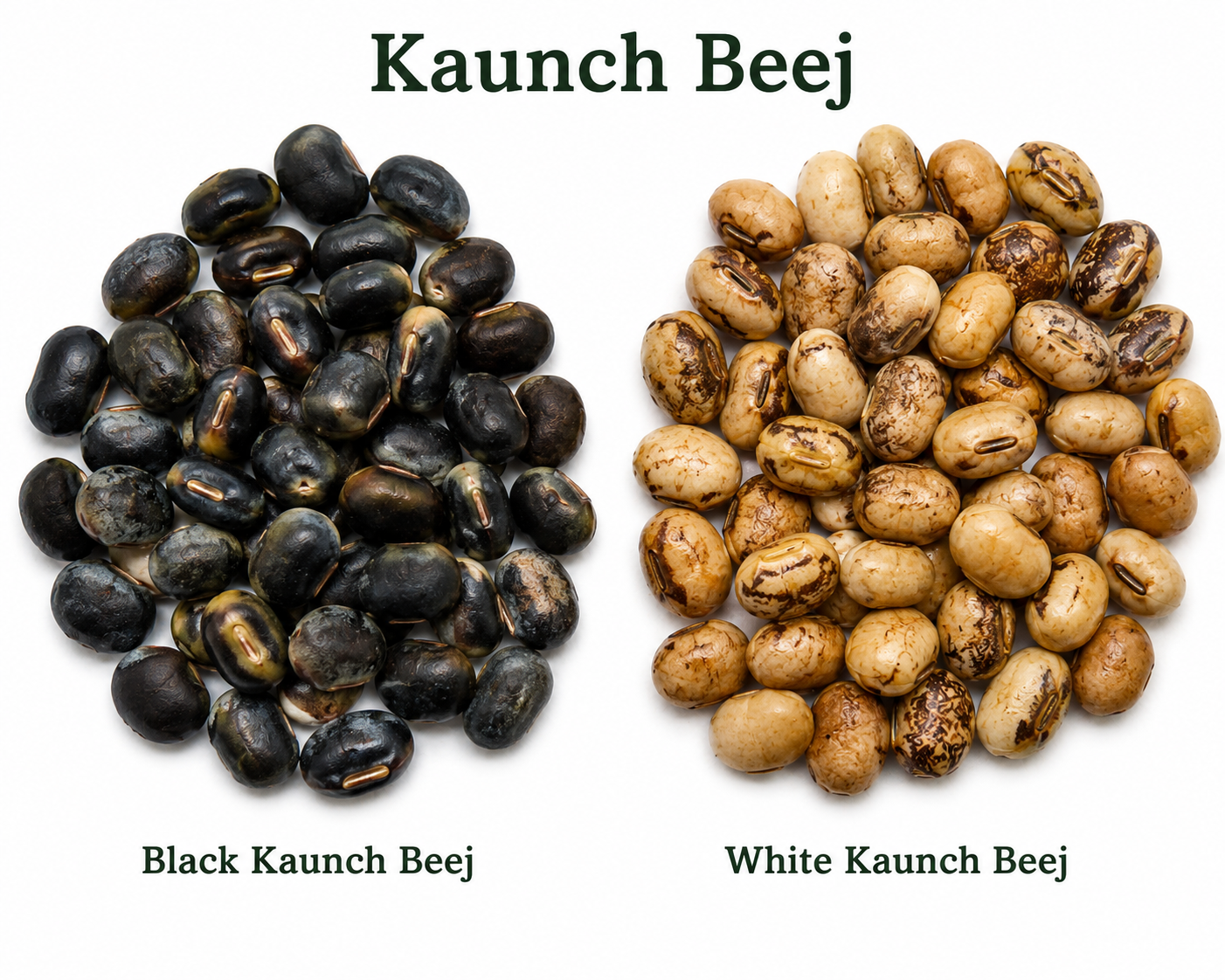
Kaunch Beej is one of the most well-known seeds used in traditional Ayurvedic wellness practices. Also called Kapikacchu or Mucuna pruriens, this seed has attracted attention for its traditional use in supporting vitality, reproductive health, and nervous-system function.
What makes Kaunch Beej especially interesting is its naturally occurring L-DOPA, a compound that the body can convert into dopamine. Because of this, researchers have studied Mucuna pruriens in areas such as male fertility and Parkinson’s disease.
However, not every claim made online about Kaunch Beej is supported by strong scientific evidence. Some research is promising, while other popular claims still require better human studies.
This guide explains Kaunch Beej benefits, traditional uses, dosage considerations, side effects, safety precautions, and the latest scientific perspective in simple language.
What You’ll Learn
- What Kaunch Beej is
- Scientific name and other names
- Traditional Ayurvedic uses
- Potential Kaunch Beej benefits
- Kaunch Beej and male fertility
- Kaunch Beej and testosterone
- Its relationship with L-DOPA and dopamine
- Potential role in Parkinson’s disease
- How Kaunch Beej is consumed
- Dosage considerations
- Possible side effects
- Safety precautions and drug interactions
- How to choose a quality product
- Frequently asked questions
What Is Kaunch Beej?
Kaunch Beej is the seed of the plant Mucuna pruriens, a tropical legume belonging to the Fabaceae family. In Ayurveda, it is commonly known as Kapikacchu. In English, the plant is often called velvet bean, cowhage, or cowitch.
The plant is native to tropical regions and has been used traditionally in different parts of Asia and Africa.
Kaunch Beej is particularly notable because the seeds naturally contain L-DOPA (L-3,4-dihydroxyphenylalanine). L-DOPA is a precursor to dopamine, a neurotransmitter involved in movement, motivation, mood, and several other biological functions.
Quick facts about Kaunch Beej
| Feature | Information |
|---|---|
| Common name | Kaunch Beej |
| Ayurvedic name | Kapikacchu |
| Scientific name | Mucuna pruriens |
| English name | Velvet bean |
| Plant family | Fabaceae |
| Notable compound | L-DOPA |
| Common forms | Powder, capsules, extracts, Ayurvedic formulations |
| Traditional uses | Vitality, reproductive health, general wellness |
| Research areas | Male fertility, dopamine pathways, Parkinson’s disease |
The presence of L-DOPA makes Kaunch Beej different from many ordinary herbal supplements. It is a biologically active ingredient, so users should approach it with the same care they would give to any supplement that can affect the body.
Kaunch Beej Benefits: What Does Research Suggest?
Kaunch Beej is traditionally associated with several potential health benefits. Modern researchers have also investigated its active compounds.
However, the evidence is not equally strong for every claimed benefit.
1. May Support Male Fertility
One of the most interesting research areas for Mucuna pruriens is male reproductive health.
Some human studies involving infertile men have reported improvements in semen parameters, including sperm count and sperm motility, following Mucuna-based treatment.
Researchers have also studied possible changes in reproductive hormones and stress-related markers.
This has led to growing interest in Kaunch Beej as a potential supportive herb for male reproductive wellness.
However, it is important to understand that research involving specific groups of infertile men does not prove that Kaunch Beej will improve fertility in every person.
Male infertility can have many causes, including:
- Hormonal problems
- Varicocele
- Infections
- Poor sperm production
- Genetic factors
- Lifestyle factors
- Certain medications
- Metabolic conditions
Therefore, Kaunch Beej should not replace a proper fertility evaluation.
Key takeaway: Research is promising, but more high-quality clinical trials are needed.
2. May Influence Dopamine Pathways
The most distinctive characteristic of Kaunch Beej is its natural L-DOPA content.
The body can convert L-DOPA into dopamine. Dopamine plays important roles in:
- Movement
- Motivation
- Reward
- Attention
- Mood
- Certain hormonal processes
This is why Mucuna pruriens has attracted scientific interest.
However, the presence of L-DOPA also means that Kaunch Beej should not automatically be considered risk-free.
The amount of L-DOPA may vary depending on:
- Plant variety
- Growing conditions
- Processing
- Product formulation
- Extraction method
This is one reason why standardized products may differ from ordinary raw seed powder.
3. May Have Potential in Parkinson’s Disease Research
Parkinson’s disease is one of the most important medical research areas involving Mucuna pruriens.
Parkinson’s disease is associated with reduced dopamine activity in parts of the brain involved in movement. Since L-DOPA can be converted into dopamine, conventional medical treatment often uses levodopa-based medicines.
Researchers have studied Mucuna pruriens as a natural source of L-DOPA.
Some clinical research suggests that Mucuna preparations may have potential for improving Parkinson’s symptoms. However, the available evidence remains limited compared with the large body of research supporting standard Parkinson’s treatments.
There is also an important safety issue.
A person who already takes levodopa medication should not add Kaunch Beej independently. Combining sources of L-DOPA may affect total exposure and increase the risk of unwanted effects.
Important: Kaunch Beej should not be used as a replacement for prescribed Parkinson’s medication unless specifically advised by a qualified medical professional.
4. May Support Stress and Reproductive Wellness
Traditional Ayurvedic use of Kaunch Beej includes support for vitality and reproductive health.
Some research has explored its potential relationship with stress and fertility.
In certain studies involving infertile men, Mucuna supplementation was associated with changes in stress markers and semen-related parameters.
This is interesting because chronic psychological stress may negatively affect several aspects of reproductive health.
Still, Kaunch Beej should not be described as a proven treatment for anxiety, depression, or chronic stress.
A healthy approach to stress management should also include:
- Regular physical activity
- Adequate sleep
- Balanced nutrition
- Relaxation practices
- Social support
- Professional care when needed
5. May Support Sexual Wellness
Kaunch Beej is commonly included in Ayurvedic formulations marketed for male vitality and sexual wellness.
Its popularity in this area may be related to:
- Traditional Ayurvedic use
- Research into male fertility
- Its effect on dopamine pathways
- Interest in reproductive hormones
However, popular internet claims often go too far.
There is not enough evidence to say that Kaunch Beej will:
- Guarantee better sexual performance
- Permanently increase testosterone
- Cure erectile dysfunction
- Cure infertility
- Produce instant results
Sexual health is complex. Problems with libido or sexual performance may be linked to cardiovascular disease, diabetes, hormonal changes, stress, relationship issues, medication side effects, or other medical conditions.
If symptoms persist, identifying the underlying cause is more important than relying on a single supplement.
Kaunch Beej for Testosterone and Sperm Count
Searches for “Kaunch Beej for testosterone” and “Kaunch Beej for sperm count” are common.
Some studies involving infertile men have reported changes in testosterone and other reproductive hormones after Mucuna supplementation. Improvements in certain semen parameters have also been reported.
However, this evidence should be interpreted carefully.
What research suggests
- Some studies report improved sperm parameters.
- Some research reports changes in reproductive hormones.
- Results may differ between individuals.
- Research populations have often been relatively small.
- More high-quality studies are required.
If your goal is to improve fertility
Consider this approach:
- Consult a qualified healthcare professional.
- Get a fertility assessment if appropriate.
- Consider semen analysis when recommended.
- Identify possible underlying causes.
- Review diet, exercise, sleep, alcohol, smoking, and stress.
- Discuss supplements before starting them.
- Use a reputable product with transparent labeling.
Expert perspective: Fertility is not determined by testosterone alone. Sperm production, sperm quality, reproductive anatomy, hormones, lifestyle, and overall health all matter.
How to Take Kaunch Beej
Kaunch Beej is available in several forms, including:
- Powder
- Churna
- Capsules
- Tablets
- Extracts
- Multi-herb Ayurvedic formulations
The appropriate method of use depends on the product.
Kaunch Beej powder
Traditional Ayurvedic preparations may use Kaunch Beej powder with milk or another suitable vehicle.
However, online dosage recommendations can vary significantly.
A teaspoon of ordinary seed powder is not necessarily equivalent to a concentrated extract or standardized supplement.
A practical approach
Before taking Kaunch Beej:
- Read the product label carefully.
- Check whether it contains raw powder or an extract.
- Look for information about standardization.
- Follow the manufacturer’s recommended serving.
- Avoid combining several products containing Mucuna.
- Consult a healthcare professional if you take prescription medicines.
There is no single universal dosage that applies to every Kaunch Beej product.
The correct dose may depend on:
- Product concentration
- L-DOPA content
- Individual health
- Reason for use
- Other medicines
- Duration of use
For this reason, it is better to avoid copying a dosage from a random website and applying it to a different product.
Kaunch Beej Side Effects
Although Kaunch Beej is a natural product, it can still cause side effects.
Possible side effects may include:
- Nausea
- Vomiting
- Headache
- Digestive discomfort
- Dizziness
- Agitation
- Confusion
- Changes in blood pressure
- Sleep disturbances
- Other effects associated with dopaminergic activity
The likelihood of side effects may depend on the amount consumed and the individual’s health.
People taking concentrated extracts may have different experiences from those consuming traditional preparations.
If you experience severe or unusual symptoms after taking Kaunch Beej, stop using the product and seek medical advice.
Who Should Avoid or Use Caution With Kaunch Beej?
Not everyone should take Kaunch Beej without professional advice.
Speak with a healthcare professional before using it if you:
- Are pregnant.
- Are breastfeeding.
- Have Parkinson’s disease.
- Have a neurological condition.
- Have a psychiatric condition.
- Take antidepressants or psychiatric medicines.
- Take medicines that affect dopamine.
- Have blood-pressure problems.
- Have diabetes.
- Take multiple prescription medicines.
- Are preparing for surgery.
- Have a chronic health condition.
Special caution for Parkinson’s patients
Because Mucuna naturally contains L-DOPA, people receiving Parkinson’s treatment should be especially careful.
Do not add Kaunch Beej to a levodopa-containing treatment plan without medical supervision.
The goal should be to avoid unpredictable changes in total L-DOPA exposure.
Kaunch Beej and Drug Interactions
One of the most overlooked topics in online articles about herbal supplements is drug interaction.
Kaunch Beej may be particularly important in this regard because of its effect on dopamine pathways.
Potential concerns may exist with medicines that affect:
- Dopamine
- The central nervous system
- Blood pressure
- Blood sugar
- Psychiatric conditions
This does not mean that every person taking these medicines will experience an interaction. It means that professional advice is appropriate.
Always tell your doctor or pharmacist about herbal supplements you use.
This is especially important if you take several medications.
Kaunch Beej Powder vs Capsules vs Extracts
Not all Kaunch Beej products are the same.
| Form | Advantages | Considerations |
| Powder | Traditional and simple | Active compound concentration may vary |
| Capsules | Convenient and easy to measure | Check actual ingredient quantity |
| Extract | Potentially concentrated | May contain higher levels of active compounds |
| Standardized extract | More consistent active compound content | Usually requires greater attention to dosing |
| Ayurvedic formulation | May combine several traditional herbs | Check the complete ingredient list |
What should you check?
Before buying Kaunch Beej, look for:
- Correct botanical name
- Ingredient list
- Manufacturer details
- Batch number
- Manufacturing date
- Expiry date
- Recommended serving
- Storage instructions
- Quality testing information
Avoid products that make unrealistic claims such as “100% guaranteed testosterone increase” or “permanent cure for infertility.”
A trustworthy health product should clearly explain what it contains and avoid promising impossible results.
How to Choose Good-Quality Kaunch Beej
Product quality can make a major difference.
Follow these steps:
Step 1: Check the botanical identity
Look for Mucuna pruriens on the label.
Step 2: Check the formulation
Determine whether you are buying powder, capsules, or a concentrated extract.
Step 3: Read the ingredient list
Avoid products that hide important ingredients behind vague proprietary blends.
Step 4: Look for manufacturing information
A reputable product should provide clear information about the manufacturer and batch.
Step 5: Check the expiry date
Do not use expired herbal products.
Step 6: Be skeptical of exaggerated claims
A product promising to cure multiple diseases is a warning sign.
Step 7: Consider professional guidance
This is especially important when the product contains pharmacologically active compounds such as L-DOPA.
Kaunch Beej: Ayurveda vs Modern Science
Kaunch Beej is an excellent example of why traditional knowledge and modern science should be considered together—but not confused.
| Area | Traditional Perspective | Modern Scientific Perspective |
| Vitality | Traditionally valued as a strengthening herb | Evidence remains limited |
| Reproductive health | Used in Ayurvedic formulations | Some promising human research |
| Male fertility | Traditionally associated with reproductive wellness | Some studies report improved semen parameters |
| Dopamine | Explained through traditional concepts | L-DOPA is a biochemical dopamine precursor |
| Parkinson’s disease | Not a traditional modern diagnosis | Active area of clinical research |
| Stress | Traditional wellness use | Preliminary human research |
| Testosterone | Popular modern claim | Limited evidence for broad testosterone-boosting claims |
The most responsible way to discuss Kaunch Beej is to distinguish between traditional use, preliminary research, and established clinical evidence.
A traditional use can be valuable and worthy of research, but it does not automatically prove that the herb treats a medical condition.
Common Mistakes When Using Kaunch Beej
Mistake 1: Assuming more is better
Because Kaunch Beej is natural, some people assume high doses are harmless.
This is not true.
Mistake 2: Ignoring the L-DOPA content
L-DOPA is biologically active. It should not be treated like an ordinary nutritional ingredient.
Mistake 3: Combining multiple supplements
Taking Kaunch Beej alongside several other products marketed for dopamine, fertility, or sexual performance may increase uncertainty around total exposure.
Mistake 4: Ignoring prescription medicines
Always disclose supplements to your healthcare professional.
Mistake 5: Expecting instant results
Herbal supplements rarely produce guaranteed or immediate results.
Mistake 6: Using it instead of medical care
A supplement should not replace evaluation and treatment for infertility, Parkinson’s disease, erectile dysfunction, or other diagnosed conditions.
Frequently Asked Questions About Kaunch Beej
Is Kaunch Beej good for men?
Kaunch Beej is traditionally used for male vitality and reproductive health. Some research has explored its effects on semen parameters and reproductive hormones, but more evidence is needed.
Does Kaunch Beej increase testosterone?
Some studies have reported hormonal changes in infertile men using Mucuna preparations. However, there is not enough evidence to call Kaunch Beej a guaranteed testosterone booster.
Does Kaunch Beej increase sperm count?
Some clinical studies have reported improvements in sperm count and motility among infertile men. Results cannot be guaranteed for everyone.
Can women take Kaunch Beej?
Women should not assume that Kaunch Beej is automatically safe. Pregnant or breastfeeding women should seek professional advice before using it.
Is Kaunch Beej good for Parkinson’s disease?
Mucuna pruriens contains L-DOPA and has been studied for Parkinson’s symptoms. However, it should not replace prescribed Parkinson’s medication without medical supervision.
What are the main Kaunch Beej side effects?
Possible side effects include nausea, vomiting, headache, digestive problems, agitation, and other effects associated with its active compounds.
Can I take Kaunch Beej every day?
Daily use depends on the formulation, dose, duration, and individual health. Regular use should be discussed with a healthcare professional when medical conditions or prescription medicines are involved.
Can Kaunch Beej be taken with milk?
Kaunch Beej powder is traditionally used with milk in some Ayurvedic preparations. However, follow the instructions for the specific product you are using.
How long does Kaunch Beej take to work?
There is no universal timeline. Effects depend on the reason for use, product, dose, and individual response.
Is Kaunch Beej the same as Mucuna pruriens?
Yes. Kaunch Beej and Kapikacchu commonly refer to the seeds of Mucuna pruriens.
Is Kaunch Beej safe?
Kaunch Beej may be safe for some people when used appropriately, but it contains biologically active compounds and may interact with medicines. It should not automatically be considered risk-free.
Can Kaunch Beej cure infertility?
No. There is no evidence that Kaunch Beej can guarantee a cure for infertility. Some research is promising, but infertility requires proper medical evaluation.
Can Kaunch Beej improve sexual performance?
It is traditionally used for sexual wellness, but strong evidence for treating sexual dysfunction is limited. Persistent sexual problems should be medically evaluated.
Can I take Kaunch Beej with Ashwagandha?
Some Ayurvedic formulations may combine herbs, but combining supplements should not be assumed to be safe for everyone. Ask a qualified healthcare professional, especially if you take medicines.
Final Thoughts on Kaunch Beej
Kaunch Beej is a traditional Ayurvedic seed with an unusual and scientifically interesting profile. Its natural L-DOPA content has made Mucuna pruriens an important subject of research, particularly in areas involving dopamine pathways, Parkinson’s disease, and male reproductive health.
Some human research is encouraging, especially regarding fertility-related outcomes. At the same time, many popular claims about testosterone, sexual performance, and general health remain less certain.
The best way to approach Kaunch Beej is with a balanced mindset.
Understand what the research actually shows. Choose products carefully. Avoid excessive doses. Consider potential drug interactions. And never use an herbal supplement as a replacement for necessary medical treatment.
If you are considering Kaunch Beej for a specific health goal, especially fertility, Parkinson’s disease, or a condition requiring medication, speak with a qualified healthcare professional before starting it.
Kaunch Beej may have potential, but informed and responsible use is more important than exaggerated promises.


