


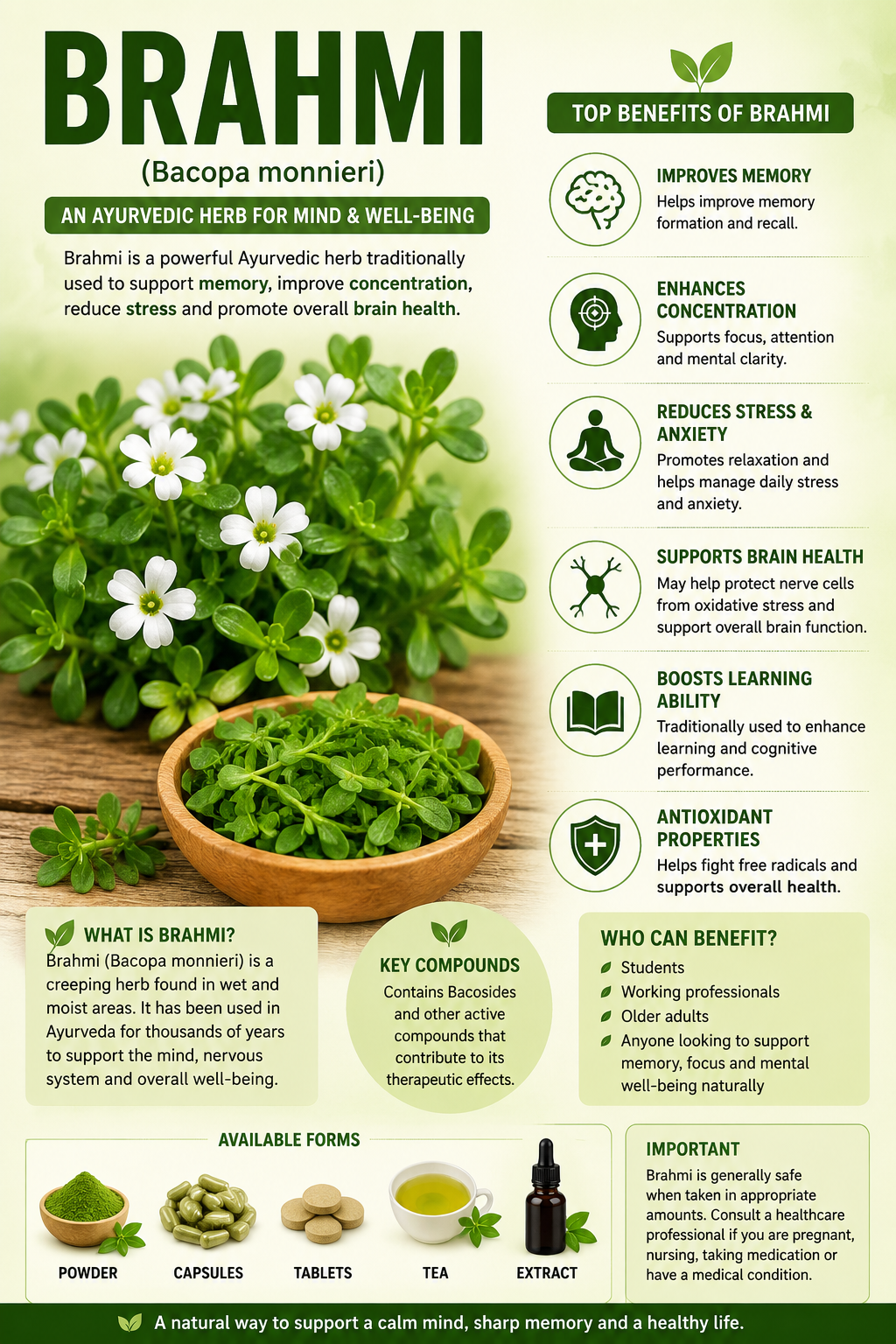
Brahmi is one of the best-known herbs in Ayurveda, traditionally valued for supporting memory, learning, mental clarity, and a calm mind. Today, it is widely available as fresh herb, powder, capsules, and standardized extracts.
But there is an important detail many articles miss: the name Brahmi does not always refer to the same plant. In many Indian markets, the name may refer to Bacopa monnieri, while in some regions Centella asiatica is also called Brahmi. These are different plants with different chemical constituents.
This guide focuses primarily on Brahmi as Bacopa monnieri and explains its traditional uses, potential benefits, research evidence, dosage considerations, safety, and how to choose a quality product.
What You’ll Learn
In this guide, you’ll discover:
- What Brahmi is
- Brahmi’s traditional Ayurvedic uses
- Potential benefits for memory and cognition
- What research says about stress and anxiety
- How Brahmi may work
- Brahmi powder vs. standardized extracts
- General dosage considerations
- Possible side effects
- Drug interactions and precautions
- Brahmi vs. Gotu Kola
- How to choose a quality Brahmi supplement
- Frequently asked questions
What Is Brahmi?
Brahmi is a traditional Ayurvedic herb commonly used to refer to Bacopa monnieri, a small creeping plant that grows in moist environments. It has a long history of use in traditional medicine, particularly in preparations associated with memory, learning, mental clarity, and nervous-system support. Modern research has investigated its possible effects on cognition, memory, anxiety, and oxidative stress.
The plant is also known as:
- Bacopa
- Bacopa monnieri
- Water hyssop
- Jal Brahmi
- Brahmi herb
The herb contains naturally occurring compounds called bacosides and related saponins, which are among the compounds researchers study when investigating Bacopa’s biological activity.
Brahmi at a glance
| Feature | Information |
|---|---|
| Common name | Brahmi |
| Scientific name | Bacopa monnieri |
| Traditional system | Ayurveda |
| Common plant part | Aerial parts |
| Key studied compounds | Bacosides and related saponins |
| Traditional focus | Memory, learning, mental clarity |
| Modern research areas | Cognition, memory, anxiety, neuroprotection |
| Common forms | Powder, capsules, extracts |
| Common concern | Confusion with Centella asiatica |
Important: Always check the scientific name on the label. The word “Brahmi” alone may not tell you which plant is actually in a product.
Brahmi vs. Gotu Kola: Are They the Same?
No. Brahmi and Gotu Kola are botanically different plants, although both may be called Brahmi in certain Indian regions.
- Bacopa monnieri is commonly associated with the name Brahmi.
- Centella asiatica is commonly known as Gotu Kola and Mandukaparni.
- Bacopa is known for its bacosides.
- Centella contains compounds such as asiaticoside and madecassoside.
This naming overlap is more than a technical issue. It can affect product quality, research interpretation, and consumer expectations. Botanical authentication studies have found that confusion and mislabeling can occur in herbal products.
Expert tip
When buying Brahmi, look for:
- The full scientific name.
- The plant part used.
- Extract ratio or standardization details.
- Bacoside content, when applicable.
- Batch or quality-testing information.
- Manufacturer details.
Brahmi Benefits: What Does the Research Say?
Brahmi has a long traditional history, but modern scientific evidence should be considered separately from traditional claims.
The most studied areas include:
- Memory
- Learning
- Cognitive performance
- Anxiety
- Stress-related symptoms
- Oxidative stress
- Neuroprotective mechanisms
The evidence is promising in some areas but not conclusive for every claimed benefit.
1. May Support Memory
Memory is probably the most popular reason people take Brahmi.
Clinical research has examined whether standardized Bacopa monnieri extracts can influence aspects of memory and learning. Some studies have reported improvements in measures such as delayed recall and verbal learning after sustained use rather than a single dose.
This distinction matters.
Brahmi should not be viewed as an instant “memory booster.” If benefits occur, they may require consistent use over time.
Practical takeaway: People interested in Brahmi for memory should think in terms of long-term cognitive support rather than immediate stimulation.
2. May Support Learning and Cognitive Function
Some research suggests that Bacopa may influence cognitive performance, including aspects of learning and memory acquisition.
A recent 2026 network meta-analysis reviewed 29 randomized controlled trials involving 2,107 healthy adults. The analysis reported promising results for some memory outcomes, particularly with higher-dose Brahmi preparations, although the authors also noted limitations in the evidence and the need for further research.
This is encouraging, but it does not mean every Brahmi product will produce the same results.
Product differences can include:
- Plant identity.
- Extraction method.
- Bacoside content.
- Dose.
- Study duration.
- Individual response.
3. May Help With Stress and Anxiety
Traditional Ayurvedic use has associated Brahmi with a calm and balanced mental state.
Modern research has also investigated its potential relationship with anxiety. Clinical summaries report evidence suggesting possible anxiety-reducing effects, although more high-quality research is needed to define the size and consistency of the benefit.
Brahmi may be especially interesting for people looking for an herbal option that supports cognitive function without being positioned primarily as a stimulant.
However, it should not replace professional treatment for significant anxiety or depression.
4. May Have Antioxidant and Neuroprotective Properties
Laboratory and preclinical research has explored the antioxidant and neuroprotective potential of Bacopa monnieri.
Researchers are interested in how its bioactive compounds may interact with processes involving:
- Oxidative stress.
- Inflammation.
- Cellular protection.
- Neuronal signaling.
- Apoptosis.
- Mitochondrial function.
A 2024 systematic review examined these mechanisms and highlighted the potential neuroprotective and cognitive-enhancing properties of Bacopa, while also emphasizing the need for continued research.
Important distinction
Laboratory findings do not automatically prove that the same effect occurs in humans.
This is why a trustworthy Brahmi article should distinguish:
Traditional use → Laboratory research → Animal studies → Human clinical trials
Each level provides different strength of evidence.
Brahmi for Students, Focus, and Concentration
Students and professionals often search for Brahmi because of its reputation for supporting memory and concentration.
A sensible approach is to view Brahmi as one possible component of a broader cognitive-health routine.
For better learning, combine healthy habits such as:
- Consistent sleep.
- Regular physical activity.
- Adequate hydration.
- Balanced nutrition.
- Focused study sessions.
- Reduced digital distractions.
- Stress management.
Example
A student preparing for an exam may use a structured routine:
- Study for 45–60 minutes.
- Take a short break.
- Review previously learned material.
- Get adequate sleep.
- Maintain regular exercise.
- Avoid relying solely on supplements.
Brahmi should not be considered a substitute for these foundational habits.
How Does Brahmi Work?
Scientists are still investigating the exact mechanisms behind Bacopa’s effects.
Its bioactive compounds, particularly bacosides and related saponins, are central to research.
Possible mechanisms being investigated include:
- Antioxidant activity.
- Modulation of neuronal signaling.
- Effects on synaptic communication.
- Influence on inflammatory pathways.
- Potential neuroprotective activity.
The exact human mechanism is not fully established, so claims should be presented cautiously rather than as proven facts.
Brahmi Powder vs. Capsules vs. Standardized Extract
Not all Brahmi products are equivalent.
| Form | Advantages | Considerations |
|---|---|---|
| Fresh herb | Traditional form | Less convenient |
| Powder | Easy to mix | Active compound content can vary |
| Capsules | Convenient | Quality varies by manufacturer |
| Standardized extract | More consistent active-compound profile | Usually more expensive |
| Liquid extract | Easy to consume | Concentration varies |
Which form is best?
There is no single answer for everyone.
For research-based supplementation, a standardized extract with clear labeling may be easier to evaluate than an unspecified powder because the active-compound content is more clearly defined.
The key is not simply choosing the product with the highest number on the label. Instead, consider:
- Correct botanical identity.
- Standardization.
- Third-party testing.
- Manufacturer reputation.
- Contamination testing.
- Transparent labeling.
Brahmi Dosage: How Much Should You Take?
There is no universal dose that applies to every Brahmi product.
Clinical studies have used different preparations and doses. For example, one older randomized trial in people with age-associated memory impairment used 125 mg of a standardized Bacopa extract twice daily for 12 weeks. Other studies have used different extracts and doses.
This variation shows why simply asking for “the Brahmi dosage” can be misleading.
A safer approach
- Identify the exact product.
- Check whether it is powder or extract.
- Review the standardization details.
- Follow the manufacturer’s directions.
- Avoid combining multiple products containing the same herb.
- Ask a healthcare professional if you take medications or have a medical condition.
Do not assume that 500 mg of one extract equals 500 mg of another extract.
Brahmi Side Effects and Safety
Brahmi is generally considered reasonably well tolerated in studied populations, but it can cause side effects.
Reported adverse effects may include:
- Nausea.
- Abdominal discomfort.
- Increased stool frequency.
- Diarrhea.
- Stomach cramps.
- Digestive upset.
These effects are among the most commonly reported concerns in clinical summaries.
Who should use extra caution?
Speak with a healthcare professional before taking Brahmi if you:
- Are pregnant or breastfeeding.
- Take prescription medicines.
- Have a chronic medical condition.
- Have a gastrointestinal disorder.
- Are planning surgery.
- Are giving it to a child.
- Are taking multiple herbal supplements.
Herbal does not automatically mean risk-free.
Brahmi and Medication Interactions
Potential interactions deserve attention, especially for people taking regular medication.
Because Bacopa may affect neurological pathways and gastrointestinal function, and because herbal supplements can vary in concentration, discuss its use with a healthcare professional if you take prescription medicines.
A pharmacist or physician can help assess your specific combination of:
- Prescription drugs.
- Over-the-counter medicines.
- Vitamins.
- Herbal supplements.
This is especially important when using Brahmi alongside other herbs marketed for relaxation, sleep, or cognitive enhancement.
Can Brahmi Treat Alzheimer’s Disease or Dementia?
This is an area where careful wording is essential.
Brahmi should not be promoted as a proven treatment or cure for Alzheimer’s disease or dementia.
A systematic review of randomized controlled trials found very low-certainty evidence and concluded that there was no clear difference between Bacopa and placebo or donepezil for Alzheimer’s disease outcomes. The researchers highlighted limitations such as small sample sizes and high risk of bias.
Therefore:
Brahmi may be studied for cognitive health, but current evidence does not establish it as a replacement for approved dementia treatment.
Anyone experiencing significant memory loss should seek medical evaluation rather than self-treating with supplements.
How to Choose a Good Brahmi Supplement
Use this simple checklist before purchasing.
Step 1: Check the scientific name
Look for:
Bacopa monnieri
Do not rely only on the word “Brahmi.”
Step 2: Check standardization
If an extract is used, look for clear information about its standardization and active compounds.
Step 3: Check testing
Prefer manufacturers that provide information about testing for:
- Heavy metals.
- Microbial contamination.
- Pesticide residues.
- Identity and purity.
Step 4: Check the label
Look for:
- Botanical name.
- Plant part.
- Serving size.
- Extract ratio.
- Standardization.
- Batch information.
- Manufacturer contact details.
Step 5: Avoid exaggerated promises
Be cautious of products claiming to:
- Cure dementia.
- Permanently increase IQ.
- Guarantee exam success.
- Cure anxiety.
- Replace prescription medication.
These claims go beyond what current evidence can support.
Common Mistakes People Make When Using Brahmi
Mistake 1: Assuming every Brahmi product is identical
Different products can have different extracts and concentrations.
Mistake 2: Confusing Brahmi with Gotu Kola
Always check the scientific name.
Mistake 3: Expecting immediate results
Most cognitive research involving Bacopa examines sustained use rather than an instant effect.
Mistake 4: Taking more because it is natural
Higher doses are not automatically better.
Mistake 5: Ignoring side effects
Digestive symptoms should not simply be ignored.
Mistake 6: Replacing medical treatment
Brahmi should not be used as a substitute for professional care.
Mistake 7: Buying based only on price
Cheap products may not provide enough information about botanical identity or quality.
Brahmi: Traditional Wisdom Meets Modern Research
Brahmi occupies an interesting position between traditional medicine and modern scientific research.
Ayurveda has valued the herb for generations, particularly in contexts involving memory, learning, and mental well-being.
Modern science is investigating these traditional uses through:
- Randomized controlled trials.
- Systematic reviews.
- Neurochemical research.
- Phytochemical analysis.
- Botanical authentication.
- Standardized extracts.
The strongest approach is neither to dismiss traditional knowledge nor to treat every traditional claim as scientifically proven.
Instead, consumers should ask:
What has been traditionally used?
What has been demonstrated in laboratory studies?
What has been tested in humans?
How strong is the evidence?
This evidence-based approach makes it easier to understand where Brahmi may be useful and where more research is needed.
Quick Answer: Is Brahmi Good for Memory?
Brahmi (Bacopa monnieri) may support certain aspects of memory and cognitive performance, particularly with consistent use of standardized extracts. However, results vary, and it should not be viewed as an instant memory enhancer or a treatment for dementia. Research is promising but not definitive for every cognitive condition.
Quick Answer: Can You Take Brahmi Every Day?
Some clinical studies have evaluated daily use over several weeks or months, but the appropriate amount depends on the specific preparation. Follow the product instructions and consult a healthcare professional if you take medication, have a medical condition, or plan long-term use.
Final Thoughts on Brahmi
Brahmi is a fascinating Ayurvedic herb with a long history of traditional use and a growing body of modern research.
For Bacopa monnieri, the most interesting evidence relates to memory, learning, cognitive function, and possibly anxiety, while research continues into its antioxidant and neuroprotective mechanisms. However, the evidence is not strong enough to support every health claim made in the supplement market.
The biggest lesson for consumers is simple: know exactly which plant you are buying. Because “Brahmi” can refer to different plants in different regions, checking the scientific name is an important first step.
Used thoughtfully, with realistic expectations and attention to product quality, Brahmi can be an interesting part of a broader approach to cognitive and mental well-being. It should complement—not replace—sleep, nutrition, exercise, healthy habits, and appropriate medical care.
Visual Content Suggestions
1. Brahmi Plant Identification
Type: Educational infographic
Purpose: Show readers what Bacopa monnieri looks like.
Alt Text: Brahmi Bacopa monnieri plant with green leaves and flowers
Placement: After “What Is Brahmi?”
2. Brahmi vs. Gotu Kola
Type: Comparison infographic
Purpose: Solve one of the biggest search-intent questions.
Alt Text: Brahmi Bacopa monnieri vs Gotu Kola Centella asiatica comparison
Placement: After the botanical identity section.
3. Brahmi Benefits Evidence Map
Type: Evidence chart
Purpose: Separate traditional uses, preliminary research, and stronger human evidence.
Alt Text: Brahmi benefits and scientific evidence chart
Placement: Before the benefits section.
4. How Brahmi May Work
Type: Scientific diagram
Purpose: Visually explain bacosides, oxidative stress, neuronal signaling, and cognitive research.
Alt Text: Diagram showing how Bacopa monnieri compounds may support brain health
Placement: “How Does Brahmi Work?”
5. Supplement Selection Checklist
Type: Infographic
Purpose: Help users choose quality products.
Alt Text: Brahmi supplement buying checklist for quality and authenticity
Placement: Product-selection section.
6. Brahmi Forms Comparison
Type: Comparison table/chart
Purpose: Compare powder, capsules, and standardized extracts.
Alt Text: Brahmi powder capsules and standardized extract comparison
Placement: “Brahmi Powder vs. Capsules vs. Standardized Extract.”
Internal Linking Suggestions
If this is part of an Ayurvedic or herbal-health website, consider linking to:
- Ashwagandha Benefits
- Shilajit Benefits
- Keeda Jadi: Uses and Benefits
- 100 Indian Medicinal Herbs
- Ayurvedic Herbs for Brain Health
- Natural Herbs for Stress Management
- Herbs for Memory and Concentration
- Ayurveda and Mental Wellness
- Guide to Choosing Herbal Supplements
- Common Ayurvedic Herbs and Their Uses
- Brahmi vs. Ashwagandha
- Herbal Supplements: Safety Guide
Suggested anchor text
- Brahmi benefits
- Ayurvedic herbs for memory
- herbs for concentration
- natural stress-support herbs
- Ashwagandha benefits
- Shilajit benefits
- Indian medicinal herbs
External Authority Sources
Recommended external references for the published article include:
- NCBI Bookshelf – Bacopa monnieri overview
- PubMed – Bacopa cognitive and neuroprotective research
- PubMed – Bacopa vs. Ginkgo systematic review and meta-analysis
- PubMed – Bacopa and Alzheimer’s disease systematic review
- NCBI Taxonomy – Bacopa monnieri classification
- PubChem – Bacopa monnieri information
FAQ Section
1. What is Brahmi?
Brahmi commonly refers to Bacopa monnieri, an Ayurvedic herb traditionally used for memory, learning, mental clarity, and nervous-system support.
2. What are the main benefits of Brahmi?
Research has primarily examined Brahmi for memory, learning, cognitive performance, anxiety, and possible neuroprotective effects.
3. Is Brahmi good for memory?
Research suggests that standardized Bacopa monnieri extracts may support certain memory and learning outcomes, although results vary and more research is needed.
4. Is Brahmi the same as Gotu Kola?
No. Brahmi often refers to Bacopa monnieri, while Gotu Kola is Centella asiatica. However, both plants may be called Brahmi in some regions.
5. How long does Brahmi take to work?
Brahmi is generally studied as a sustained-use supplement rather than an instant cognitive enhancer. Research trials commonly evaluate outcomes over several weeks.
6. Can Brahmi be taken daily?
Daily use has been studied in clinical research, but the appropriate dose depends on the preparation. Follow product instructions and seek professional advice when necessary.
7. Does Brahmi have side effects?
Possible side effects include nausea, diarrhea, increased stool frequency, abdominal cramps, and digestive discomfort.
8. Is Brahmi safe for children?
Children should not be given Brahmi without guidance from a qualified healthcare professional.
9. Can Brahmi cure Alzheimer’s disease?
No. Current evidence does not establish Brahmi as a proven treatment or cure for Alzheimer’s disease.
10. What is the best form of Brahmi?
A clearly labeled standardized extract may offer more consistency than an unspecified powder, but product quality and authenticity are more important than the form alone.
11. What are the active compounds in Brahmi?
Bacosides and related saponins are among the major compounds studied in Bacopa monnieri.
12. Can Brahmi reduce stress?
Some research suggests potential anxiety-reducing effects, but Brahmi should not replace professional treatment for significant anxiety or mental-health conditions.
13. Can Brahmi improve concentration?
Brahmi is traditionally used for cognitive support, and research has investigated attention and memory, but evidence differs across cognitive outcomes.
14. How should I choose a Brahmi supplement?
Check the scientific name, standardization, batch information, testing details, manufacturer transparency, and quality certifications where applicable.
15. Is Brahmi scientifically proven?
Some benefits have been investigated in human trials, especially cognitive outcomes, but evidence is not conclusive for all claimed benefits. More high-quality research is needed.


